The king’s attempt to learn and perform magic
The Tales of Beedle the BardThe king’s attempt to learn and perform magic is the central display of authority in the story of Babbitty Rabbitty: a ruler who wants magic for himself mistakes theatrical gestures for mastery, then discovers that his claim to command it has made him vulnerable to deception. His lessons take place under the shadow of organized persecution, and the eventual public test turns that private ambition into a crisis of rule. Babbitty’s interventions expose the fraud, but the story’s decisive outcome is not simply the king’s humiliation: it is his promise to protect witches and wizards and allow them to practise in peace.
Ambition and the machinery of persecution
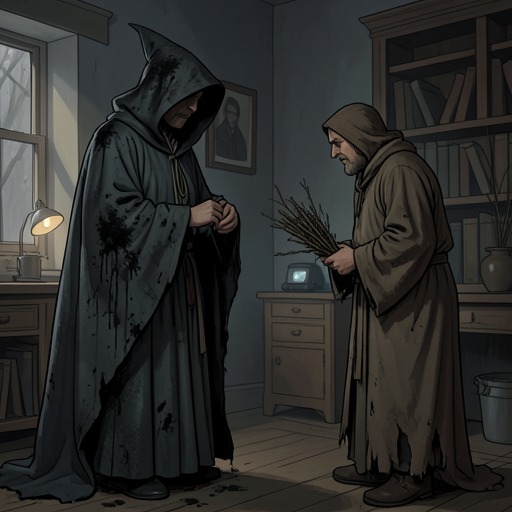
The king begins from the conviction that he alone should possess the power of magic. To pursue that aim, he orders the head of his army to form a Brigade of Witch-Hunters and supplies it with ferocious black hounds. At the same time, proclamations are read in every village and town calling for an instructor in magic. These measures work against the very expertise the king claims to seek: real witches and wizards are hiding from the hunters, so none dares volunteer for the post.
That contradiction gives the king’s ambition its political force. He seeks instruction while using state power to drive its possible teachers into concealment. Magic is treated as something the ruler can acquire by command, while those who already possess it are made targets of the institutions he has created. The story’s opening therefore links the king’s desire to learn with a broader campaign to control and suppress magic.
Lessons from a fraud
The vacancy attracts a charlatan with no magical power, who sees an opportunity to enrich himself. Claiming to be a wizard of enormous skill, he performs a few simple tricks; the king accepts them as proof and appoints him Grand Sorcerer in Chief and the King’s Private Magic Master. The appointment gives the fraud access to both royal confidence and royal resources.
The charlatan asks for a large sack of gold to buy wands and other magical necessities, several large rubies for curative charms, and silver chalices for storing and maturing potions. The king supplies them. The charlatan hides the treasure in his own house and returns to the palace grounds, having converted the king’s desire for instruction into personal gain. The episode makes the king’s error concrete: he does not merely believe a false claim, but funds it and elevates its maker to an official position.
Babbitty, the washerwoman who lives in a hovel at the edge of the palace grounds, witnesses the fraud. Peering from behind her drying sheets, she sees the charlatan snap two twigs from one of the king’s trees before returning to the palace. He gives one twig to the king and presents it as a wand of tremendous power, adding that it will work only when the king is worthy of it. The excuse protects the charlatan from immediate failure: any lack of results can be blamed on the pupil’s supposed unworthiness rather than on the worthless twig or the instructor’s lack of magic.
Every morning, the charlatan and the king go out into the grounds, wave their wands, and shout nonsense at the sky. The charlatan performs additional tricks to maintain the king’s confidence in both his skill and the expensive wands. The lessons thus operate as a repeated performance rather than instruction in magic. Their ritual motions create the appearance of progress while preserving the deception on which the king’s confidence depends.
From private practice to public test
The king’s faith in the lessons is disturbed when Babbitty watches from the window of her tiny cottage and laughs so hard that she sinks out of sight. Taking her laughter as a judgment on his appearance, he stops hopping and twirling his twig and demands to know when he will be able to perform real spells before his subjects. The charlatan soothes him with assurances that astonishing feats will soon be possible, but the king announces that the court will be invited the following day to watch him perform magic.
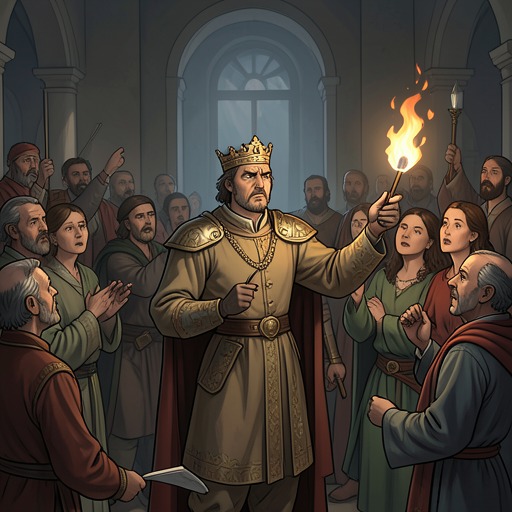
The announcement changes the stakes. The charlatan recognizes that the time has come to take the treasure and flee, and he begins to withdraw from his role. But the public demonstration proceeds: the lords and ladies assemble in the palace grounds, the king climbs onto a stage, and the charlatan stands beside him. The king points his twig at a noblewoman’s hat and declares that he will make it disappear. Concealed in a nearby bush, Babbitty uses her wand to make the hat vanish; the crowd responds with astonishment, admiration, and applause for the king.
This first feat sustains the appearance of royal power, but its actual source is Babbitty’s magic. The king’s public authority rests on an act he cannot perform, while Babbitty remains hidden and the charlatan continues to benefit from the deception. The applause rewards the king without revealing who has made the feat possible, allowing the mistaken belief at the heart of the lessons to survive for another moment.
The limit of the performance
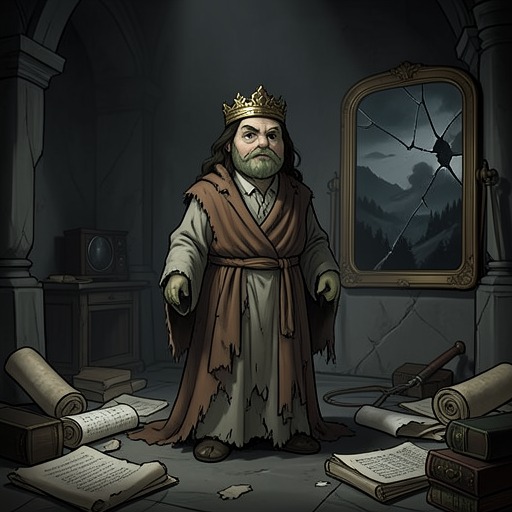
The decisive test comes when the king points his twig at a dead dog and it does not stir. Babbitty, still inside the bush, smiles but does not raise her wand: no magic can bring the dead back to life. The crowd first whispers and then laughs, suspecting that the king’s earlier feats were tricks as well. The failed attempt exposes a boundary that the charlatan’s staged lessons had concealed: magic cannot accomplish everything a ruler may demand of it.
The charlatan responds not by confessing but by redirecting suspicion. He points toward the bush, claims to see a wicked witch blocking the king’s magic, and orders that she be seized. The king’s failed performance thus becomes an occasion for renewed persecution. The Brigade of Witch-Hunters pursues Babbitty with its hounds, but when she reaches a low hedge she vanishes from sight. The king, charlatan, and courtiers find the hounds barking and scrabbling around a bent, aged tree.
The apparent transformation gives Babbitty a way to answer the accusation, but it also reveals how readily the king and his court accept claims that suit their assumptions about magic. In the accompanying commentary, the king is described as a Muggle who covets and fears magic and supposes that learning incantations and waving a wand can make him a wizard. The narrative’s public tests expose the gap between that fantasy of command and the actual limits of magic: the king cannot perform the spells, and the dead cannot be restored.
A threat turned into a royal promise
The charlatan’s deception is finally exposed when the tree stump challenges the king to have the alleged witch cut in half, insisting that no witch or wizard can be killed that way and demanding that the king test the claim on his own Grand Sorcerer. The Captain of the Brigade of Witch-Hunters is eager to conduct the experiment. Faced with the prospect, the charlatan falls to his knees, begs for mercy, and confesses his wickedness; he is dragged away to the dungeons. The stump’s laughter grows louder as the king’s instructor is unmasked.
Babbitty then tells the petrified king that cutting a witch in half has unleashed a curse: from then on, every harm he inflicts on his fellow witches and wizards will feel like an axe stroke in his own side, until he wishes he could die of it. The threat gives the king a direct consequence for continuing the persecution he initiated. He falls to his knees and promises to issue a proclamation protecting all the witches and wizards of the kingdom and allowing them to practise magic in peace. The stump accepts the promise but says that the king has not yet made amends to Babbitty, distinguishing a general change of policy from the specific debt owed to the person he has wronged.
The episode therefore ends the king’s attempt not with genuine magical achievement but with a reversal in how he uses royal power. He begins by seeking exclusive command of magic and building an apparatus to hunt its practitioners; after his lessons fail, his public display collapses, and the fraud is confessed, he promises protection and freedom to practise. The story’s later commentary also situates its concern with coercive magic historically: it notes that the Cruciatus, Imperius, and Avada Kedavra Curses were first classified as Unforgivable in 1717, whereas in Beedle’s time the Cruciatus Curse had not yet been made illegal. That context underscores the difference between a ruler’s threat of punishment and a later formal prohibition, while the events of the tale turn the king’s own promised consequences into an instrument for ending his persecution.